
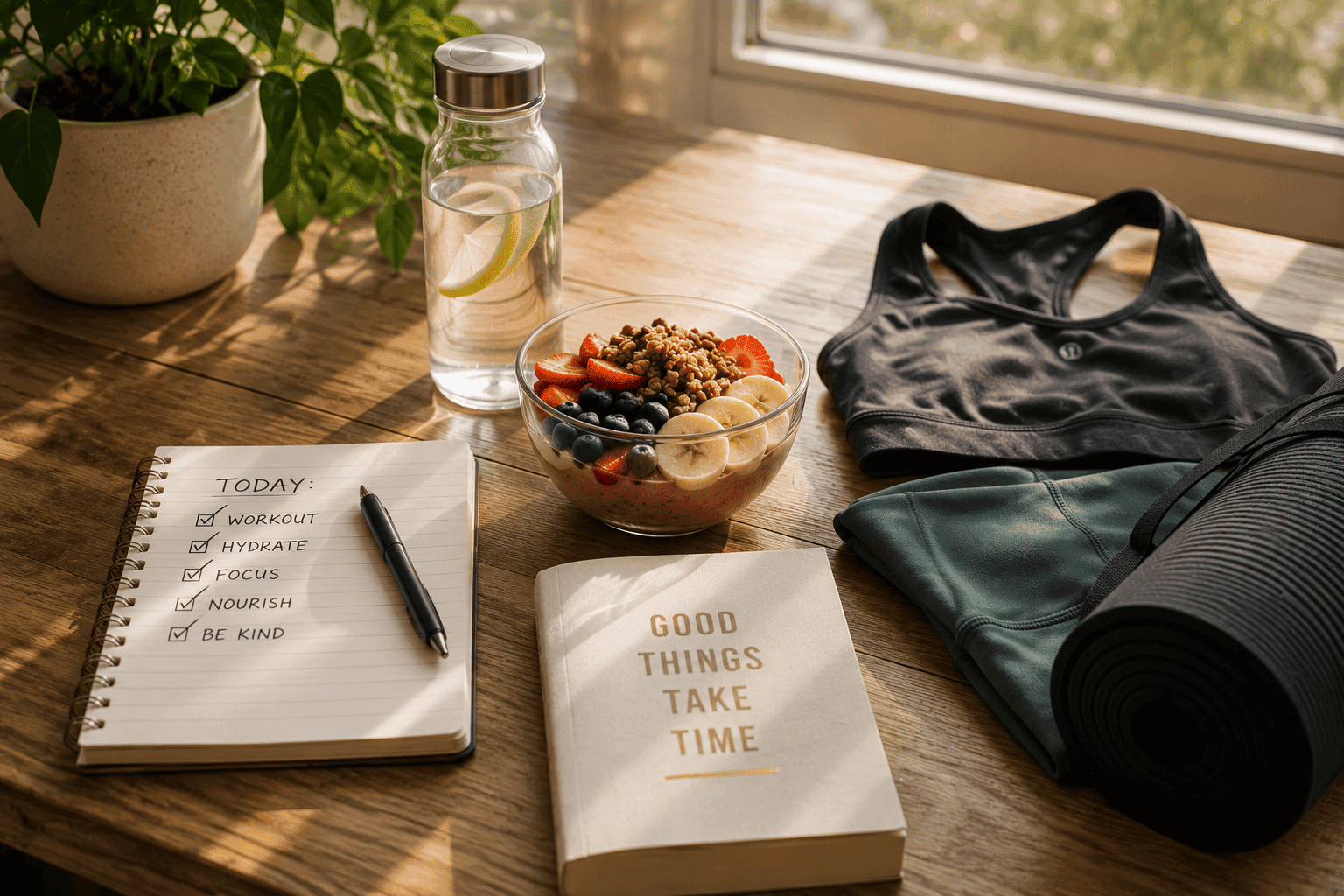
How Building Better Routines Can Improve Your Entire Life: The Domino Effect of Discipline
You Are Your Routines
We like to think that our lives are shaped by big decisions—where we go to college, who we marry, or what career we choose. But in reality, your life is shaped by the small, repetitive actions you take every single day. These are your Routines.
Aristotle said it best: "We are what we repeatedly do. Excellence, then, is not an act, but a habit."
If your routines are chaotic, your life will feel chaotic. If your routines are disciplined and intentional, your life will feel purposeful and energized. Fitness is often the "lead domino" in this process. When you build a routine around your health, it has a ripple effect that improves your productivity, your relationships, and your mental clarity. In this article, we’ll explore the science of building better routines and how you can use them to transform your entire life.
---
1. Reducing Decision Fatigue: Automating Your Success
The biggest enemy of progress is Decision Fatigue.
Every day, you have a limited amount of mental energy to make decisions.
- "What should I eat for breakfast?"
- "Should I go to the gym now or later?"
- "Which workout should I do?"
By mid-afternoon, your "decision budget" is empty. This is when you make bad choices—you skip the gym, you order takeout, and you scroll on your phone for hours.
A Routine removes the need for decisions. When your workout is scheduled at 7:00 AM, you don't "decide" to go; you just go. When your meals are planned using our [macro calculator](https://gymguide.co/macro-calculator), you don't "decide" what to eat; you just eat. Routines "automate" the hard work, saving your mental energy for the things that actually require your creativity and focus.
---
2. The "Domino Effect": How One Habit Cascades into Others
Habits don't exist in isolation. They are interconnected. This is the Domino Effect.
When you start a fitness routine, you often find that other areas of your life improve "automatically."
- You go to the gym (Lead Domino).
- Because you worked out, you want to "fuel" correctly, so you eat a better lunch.
- Because you ate well and moved, you have more energy, so you are more productive at work.
- because you were productive, you feel less stressed, so you are kinder to your partner in the evening.
- Because you are less stressed, you sleep better.
By focusing on one "Keystone Habit"—like following our [exercise guide](https://gymguide.co/exercises)—you are triggering a chain reaction of positive changes throughout your entire life.
---
3. Morning Routines: Setting the Intention for the Day
The first hour of your day is the "rudder" that steers the rest of your day.
If you wake up, check your phone immediately, and rush into your emails, you are starting the day in a Reactive State. You are letting the world dictate your mood and priorities.
A Proactive Morning Routine puts you in control.
- Hydration: 500ml of water to wake up your organs.
- Movement: A 10-minute walk or stretch to clear the "brain fog."
- Focus: 10 minutes of quiet time or planning before the digital noise begins.
By winning the morning, you build a "buffer" of peace and discipline that carries you through even the most stressful afternoons.
---
4. Evening Routines: The Secret to High-Performance Recovery
High performance is a result of high-quality recovery. As we’ve discussed in our article on "How Poor Sleep Affects Hunger," your evening routine determines your metabolic and mental state for the next day.
A good evening routine should be about "downregulating" your nervous system.
- Shutdown Ritual: Finalize your to-do list for tomorrow so your brain can stop "looping" on tasks.
- Digital Sunset: Turn off screens 60 minutes before bed to allow melatonin production.
- Cool Down: Use a cool room and perhaps some light mobility from our [exercise guide](https://gymguide.co/exercises) to signal to your body that it’s time to sleep.
Your morning starts the night before. If you want a productive Wednesday, you must have a disciplined Tuesday night.
---
5. Environmental Design: Building a Home for Your Routine
Willpower is a fragile resource. The best way to maintain a routine is to make it so easy that it doesn't require willpower. This is Environmental Design.
- If you want to workout in the morning, put your gym clothes and shoes out the night before.
- If you want to eat healthier, prep your meals using our [calorie calculator](https://gymguide.co/calorie-calculator) and keep them at the front of the fridge.
- If you want to read more, put a book on your pillow.
You should "curate" your environment to support the habits you want and create friction for the habits you don't. If the healthy choice is the easiest choice, your routine will become unbreakable.
---
6. The Role of "Anchor Habits" in Maintaining Consistency
An Anchor Habit is something you already do every day without thinking (e.g., brushing your teeth, making coffee, checking the mail).
The most effective way to build a new routine is Habit Stacking. You "anchor" the new habit to an existing one.
- "After I brush my teeth, I will do 1 minute of stretching."
- "After I make my coffee, I will plan my meals for the day."
- "After I finish my work day, I will immediately go to the gym."
By attaching the new behavior to an established anchor, you are borrowing the neural "momentum" of the old habit. It makes the new routine feel like a natural extension of your life rather than an "extra" chore.
---
7. How to Build a Routine That Sticks
To transform your life, you don't need a "perfect" routine; you need a "stable" one.
The "Goldilocks" Rule of Difficulty
Your routine should be "just right"—not so easy that it’s boring, but not so hard that it’s overwhelming. If you try to change 10 things at once, you will fail. Change one thing. Once it’s automatic, add the next.
Using Technology and Tracking as a Mirror
What gets measured gets managed. Use our [BMI calculator](https://gymguide.co/bmi-calculator) and [calorie calculator](https://gymguide.co/calorie-calculator) to track your physical progress, but also keep a simple "Habit Tracker" for your routine. Seeing a "streak" of successful days provides the dopamine reinforcement needed to keep going.
The Importance of a "Weekly Review"
Every Sunday, spend 15 minutes reviewing your week. What went well? Where did your routine break down? How can you adjust for next week? A routine isn't a static set of rules; it’s an evolving system that adapts to your life.
---
Conclusion: The Quiet Power of Discipline
Discipline is not about "punishing" yourself. It is about freedom.
- A routine gives you the freedom from decision fatigue.
- A routine gives you the freedom from health issues.
- A routine gives you the freedom to pursue your biggest goals with energy and focus.
Building better routines is the single most effective way to improve your entire life. It starts with the "lead domino" of your health. When you master your body, you build the confidence and discipline to master your world.
One habit at a time. One day at a time. Let’s get to work.
---
Frequently Asked Questions (FAQ)
1. How long does it take to form a new routine?
Research shows it takes an average of 66 days for a new behavior to become automatic. Some simple habits take less time; complex ones (like a gym routine) take more. The key is consistency, not perfection.
2. What if my schedule is unpredictable?
Use "If-Then" Planning. "If I can't go to the gym at 5:00 PM because of work, then I will do a 20-minute bodyweight workout at home." This prevents a change in schedule from breaking your routine.
3. Is it okay to have "cheat days" in my routine?
Yes! A lifestyle requires flexibility. A "cheat day" or a rest day shouldn't be a "break" from your routine; it should be a part of your routine. Use our [calorie calculator](https://gymguide.co/calorie-calculator) to balance your week.
4. Can routines stifle creativity?
Actually, the opposite is true. By automating the "mundane" parts of your life (food, exercise, chores), you free up massive amounts of mental energy for your creative work. Most of history's greatest artists and thinkers had extremely rigid daily routines.
5. What is the most important routine to start with?
Sleep. If you are well-rested, every other habit is 10x easier. As discussed in our article on "How Poor Sleep Affects Hunger," a tired brain cannot maintain a disciplined routine. Start with your evening routine.
---
Related Posts:- [The Science of Building Better Daily Habits](/blog/the-science-of-building-better-daily-habits)
- [Why Discipline Beats Motivation Every Time](/blog/why-discipline-beats-motivation-every-time)
- [How Fitness Can Improve Productivity and Energy Levels](/blog/how-fitness-can-improve-productivity-and-energy-levels)
🚀 Ready to start your transformation?
Download GymGuide Free →