
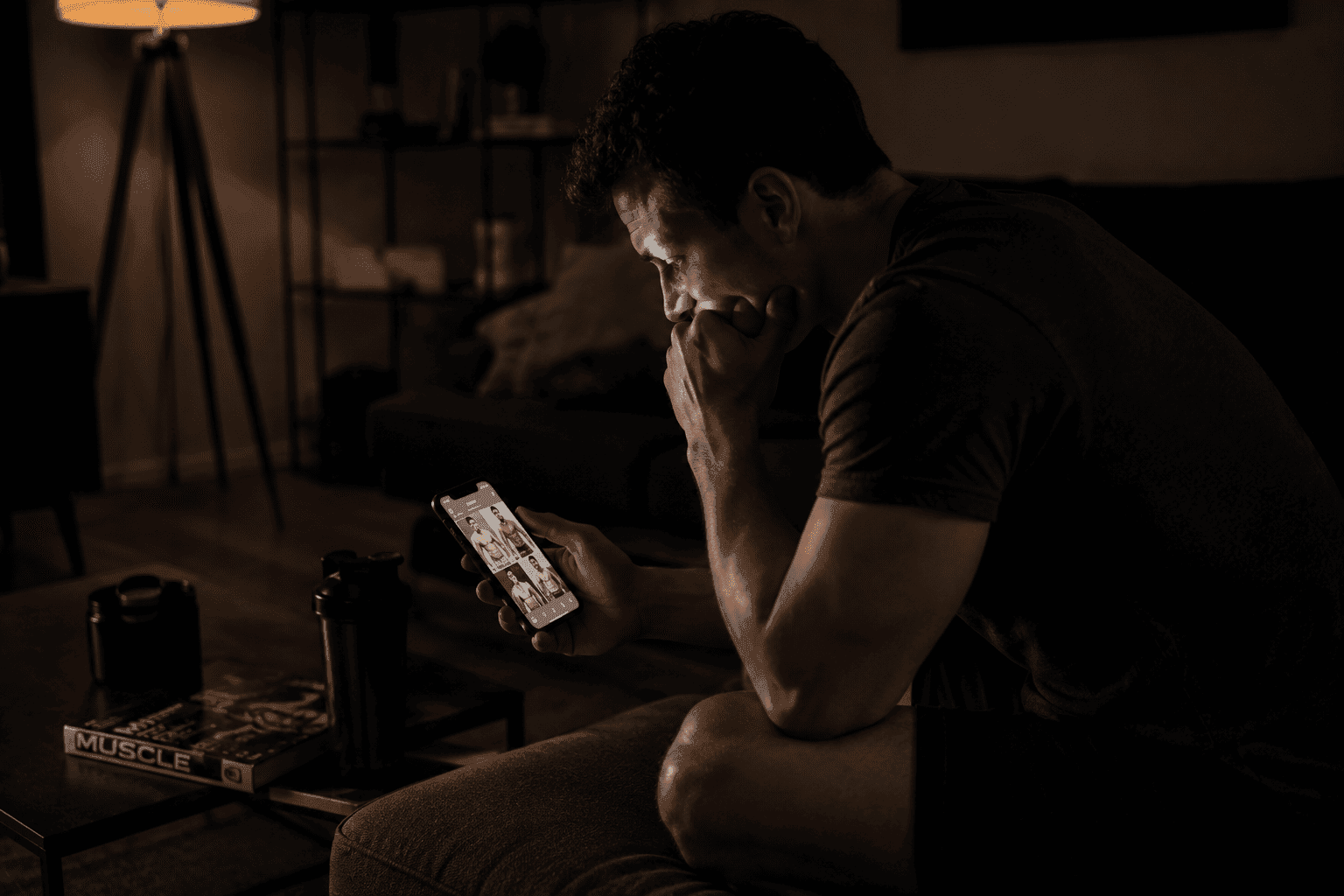
How Social Media Creates Unrealistic Fitness Expectations: Navigating the Digital Distortion
The Filtered Reality: Why We’re Losing Touch with What’s Possible
If you open Instagram or TikTok right now, you will be bombarded with "perfect" bodies. You’ll see six-pack abs that never seem to go away, athletes who never seem to get tired, and transformations that claim to have happened in just 30 days.
For the average person, this is a psychological minefield. We are biologically wired for social comparison—our ancestors survived by constantly assessing where they stood in the tribal hierarchy. But our ancestors were comparing themselves to the 50 people in their village. We are comparing ourselves to the top 0.001% of the world's most genetically gifted, highly trained, and digitally enhanced individuals.
The result is a widespread sense of inadequacy. We feel like failures because we don't look like people who don't actually look like that in real life. In this article, we’ll pull back the curtain on how social media distorts fitness reality and how you can protect your mental health while chasing your physical goals.
---
1. The Illusion of Perfection: Lighting, Angles, and Editing
The first thing to understand is that a photo on social media is a "product," not a "reflection."
A fitness influencer doesn't just "take a picture." They spend hours finding the perfect "golden hour" lighting. They use "pump-inducing" exercises right before the shoot. They know exactly which angles create the illusion of a smaller waist or larger muscles.
More importantly, almost every professional fitness photo is edited.
- Filters: Adjusting contrast and shadows can make muscles look much more defined than they are in normal light.
- Retouching: Skin textures, stretch marks, and minor "imperfections" are erased.
- Liquify Tools: Modern apps allow for subtle (and sometimes not-so-subtle) changes to body proportions.
When you compare your reflection in the harsh fluorescent lighting of a gym bathroom to a professionally curated digital product, you are playing a game you cannot win.
---
2. The "Instant" Transformation Myth: Why Timelines are Distorted
Social media thrives on "Before and After" photos. They are the ultimate engagement drivers. However, these photos often hide the truth of how long change actually takes.
Many "12-week transformations" are actually the result of years of previous training. The "before" photo is often taken after a period of intentional weight gain or poor lighting, while the "after" photo is taken at the absolute peak of a grueling cut.
Furthermore, some influencers use "misleading timelines." They might post a transformation that they claim took 3 months, when it actually took 3 years. This creates a "standard of speed" that is biologically impossible for most people. When a beginner doesn't see those same results in 12 weeks, they assume they have "bad genetics" or a "slow metabolism" and they quit. Real transformation is a slow, boring process of years, not a flashy montage of weeks.
---
3. The Impact of Filters and AI-Enhanced Images on Body Satisfaction
We have moved beyond simple photo editing into the era of AI and real-time video filters. There are now filters that can add "muscle definition" or "waist-snatching" effects to live video.
This creates a "Hyper-Reality." We start to see these filtered versions of people as the "standard." When we look at real humans in the real world, they start to look "unfinished" or "flawed."
Studies have shown that even when users know an image is edited, it still negatively impacts their body satisfaction. The brain processes the visual information faster than the logical mind can debunk it. Constant exposure to these "digital ideals" leads to a permanent state of dissatisfaction with one’s own physical reality.
---
4. The Danger of Comparing Your "Behind-the-Scenes" to Their "Highlight Reel"
You see every "unfiltered" moment of your life. You see yourself when you’re tired, when you’re bloated, when you’re messy, and when you’re struggling with a workout.
On social media, you only see everyone else's "Highlight Reel." You see the one workout where they felt great, the one meal that looked beautiful, and the one photo out of a hundred that looked perfect.
Comparing your "Behind-the-Scenes" to someone else’s "Highlight Reel" is a recipe for depression. It creates the illusion that everyone else has it "all figured out" while you are the only one struggling. In reality, everyone is struggling. Even the influencers you admire have bad days, poor workouts, and moments of deep insecurity. They just don't post them.
---
5. Social Media and the Rise of Body Dysmorphia
The constant pressure to look a certain way has led to a significant increase in Muscle Dysmorphia (often called "Bigorexia") and Body Dysmorphic Disorder.
These are conditions where an individual becomes obsessed with perceived flaws in their appearance. They might look at themselves in the mirror and see "weakness" or "fat," even if they are in excellent shape. Social media acts as an "echo chamber" for these insecurities. By following accounts that prioritize extreme leanness or massive muscle mass, users normalize "disordered" levels of body fat and training intensity.
What was once "extreme" is now seen as "the baseline." This leads to a dangerous "more is never enough" mentality that can result in overtraining, eating disorders, and the use of performance-enhancing drugs (PEDs) to achieve a "social media ready" look.
---
6. Influencer Marketing vs. Scientific Reality
Many fitness influencers are not experts; they are marketers. Their goal is to sell you a program, a supplement, or a lifestyle. To do this, they often use "reductive" logic.
- "Do this one exercise for a big chest!"
- "Drink this tea to lose belly fat!"
- "Follow my exact 1200-calorie diet to look like me!"
These claims often fly in the face of basic exercise science and biology. Fitness is highly individual. What works for a 22-year-old with elite genetics and no job might be a disaster for a 40-year-old parent with a high-stress career. Social media discourages the "nuance" and "patience" required for real health, favoring "hacks" and "shortcuts" that don't exist.
---
7. How to Curate a Healthy Digital Environment
You are the gatekeeper of your own attention. To maintain your sanity while pursuing your fitness goals, you must be intentional about your digital consumption.
The "Unfollow" Protocol
If an account makes you feel "less than," "anxious," or "unhappy" with your own progress—unfollow it. You don't owe anyone your attention. Follow people who show the "messy" side of fitness, who prioritize health over aesthetics, and who provide evidence-based information.
Recognizing "Engagement-Driven" Content
When you see a controversial or extreme fitness claim, ask yourself: "Is this true, or is this designed to get comments?" Most extreme claims on social media are "engagement bait." They are designed to trigger an emotional response, not to educate you.
Focus on Personal Progress Metrics
The only comparison that matters is you today vs. you yesterday.
- Use our [BMI calculator](https://gymguide.co/bmi-calculator) and [calorie calculator](https://gymguide.co/calorie-calculator) to track your own data.
- Celebrate your own PRs (Personal Records) using our [exercise guide](https://gymguide.co/exercises).
Objective data is the best antidote to digital distortion.
---
Conclusion: Living in the Real World
Social media is a tool, but it is a tool that was designed to exploit your insecurities for profit. Don't let a screen dictate your self-worth.
Your body is a biological marvel, not a digital product. It is meant for movement, for strength, and for life—not just for a photo. Celebrate your "unfiltered" progress. Embrace the slow, messy reality of change. And remember: the best "likes" you can ever receive are the ones you give yourself when you show up and do the work, regardless of how you look in a selfie.
Real life happens offline. Go live it.
---
Frequently Asked Questions (FAQ)
1. Are all fitness influencers "fake"?
No! There are many incredible, evidence-based professionals who use social media to educate and inspire. The key is to look for people who prioritize long-term health, who acknowledge the role of genetics, and who aren't constantly trying to sell you a "quick fix."
2. Is it okay to look at "fitness inspiration" (fitspo)?
It depends on your mindset. If it motivates you to work out, that’s great. But if it leads to "comparison-itis" and makes you feel bad about your current body, it’s counterproductive. Pay attention to how you feel after 15 minutes of scrolling.
3. How can I tell if a photo is edited?
Look for "warping" in the background (curved walls or doors), unnaturally smooth skin textures, or "glowing" edges around the body. However, modern editing is so good that it’s often impossible to tell. The safest bet is to assume every professional photo has some level of enhancement.
4. Why does social media make me crave junk food?
Because "Food Porn" is a supernormal stimulus. Seeing hyper-palatable food triggers a dopamine release that can create "cravings" even if you aren't hungry. If you’re trying to stick to your goals in our [macro calculator](https://gymguide.co/macro-calculator), it’s best to avoid food-heavy accounts.
5. What should I do if I feel obsessed with my appearance?
If your concern about your body is interfering with your daily life, happiness, or social relationships, consider talking to a mental health professional. Body dysmorphia is a real and serious issue, and social media can significantly worsen it.
---
Related Posts:- [How Dopamine Addiction Is Affecting Fitness and Productivity](/blog/how-dopamine-addiction-is-affecting-fitness-and-productivity)
- [The Link Between Confidence and Physical Activity](/blog/the-link-between-confidence-and-physical-activity)
- [Why Most People Quit Fitness After 30 Days](/blog/why-most-people-quit-fitness-after-30-days)
🚀 Ready to start your transformation?
Download GymGuide Free →